 Add to Chrome
 Add to Firefox
 Add to Edge
Uni-Edit: Intelligent Editing Is A General Task For Unified Model Tuning
May 20, 2026
Currently, enhancing Unified Multimodal Models (UMMs) with image understanding, generation, and editing capabilities mainly relies on mixed multi-task training. Due to inherent task conflicts, such strategy requires complex multi-stage pipelines, massive data mixing, and balancing tricks, merely resulting in a performance trade-off rather than true mutual reinforcement. To break this paradigm, we propose Uni-Edit, an intelligent image editing task that serves as the first general task for UMM tuning. Unlike complex mixed pipelines, Uni-Edit improves performance across all three abilities at once using only one task, one training stage, and one dataset. Specifically, we first identify image editing as an inherently ideal general task, as it naturally demands both visual understanding and generation. However, existing editing data relies on simplistic instructions that severely underutilize a model's understanding capacity. To address this, we introduce the first automated and scalable data synthesis pipeline for intelligent editing, transforming diverse VQA data into complex and effective editing instructions with embedded questions and nested logic. This yields Uni-Edit-148k, pairing diverse reasoning-intensive instructions with high-quality edited images. Extensive experiments on BAGEL and Janus-Pro demonstrate that tuning solely on Uni-Edit achieves comprehensive enhancements across all three capabilities without any auxiliary operations.

UGID: Unified Graph Isomorphism for Debiasing Large Language Models
Mar 19, 2026Large language models (LLMs) exhibit pronounced social biases. Output-level or data-optimization--based debiasing methods cannot fully resolve these biases, and many prior works have shown that biases are embedded in internal representations. We propose \underline{U}nified \underline{G}raph \underline{I}somorphism for \underline{D}ebiasing large language models (\textit{\textbf{UGID}}), an internal-representation--level debiasing framework for large language models that models the Transformer as a structured computational graph, where attention mechanisms define the routing edges of the graph and hidden states define the graph nodes. Specifically, debiasing is formulated as enforcing invariance of the graph structure across counterfactual inputs, with differences allowed only on sensitive attributes. \textit{\textbf{UGID}} jointly constrains attention routing and hidden representations in bias-sensitive regions, effectively preventing bias migration across architectural components. To achieve effective behavioral alignment without degrading general capabilities, we introduce a log-space constraint on sensitive logits and a selective anchor-based objective to preserve definitional semantics. Extensive experiments on large language models demonstrate that \textit{\textbf{UGID}} effectively reduces bias under both in-distribution and out-of-distribution settings, significantly reduces internal structural discrepancies, and preserves model safety and utility.
Functional Subspace Watermarking for Large Language Models
Mar 19, 2026Model watermarking utilizes internal representations to protect the ownership of large language models (LLMs). However, these features inevitably undergo complex distortions during realistic model modifications such as fine-tuning, quantization, or knowledge distillation, making reliable extraction extremely challenging. Despite extensive research on model-side watermarking, existing methods still lack sufficient robustness against parameter-level perturbations. To address this gap, we propose \texttt{\textbf{Functional Subspace Watermarking (FSW)}}, a framework that anchors ownership signals into a low-dimensional functional backbone. Specifically, we first solve a generalized eigenvalue problem to extract a stable functional subspace for watermark injection, while introducing an adaptive spectral truncation strategy to achieve an optimal balance between robustness and model utility. Furthermore, a vector consistency constraint is incorporated to ensure that watermark injection does not compromise the original semantic performance. Extensive experiments across various LLM architectures and datasets demonstrate that our method achieves superior detection accuracy and statistical verifiability under multiple model attacks, maintaining robustness that outperforms existing state-of-the-art (SOTA) methods.
FaithSteer-BENCH: A Deployment-Aligned Stress-Testing Benchmark for Inference-Time Steering
Mar 18, 2026Inference-time steering is widely regarded as a lightweight and parameter-free mechanism for controlling large language model (LLM) behavior, and prior work has often suggested that simple activation-level interventions can reliably induce targeted behavioral changes. However, such conclusions are typically drawn under relatively relaxed evaluation settings that overlook deployment constraints, capability trade-offs, and real-world robustness. We therefore introduce \textbf{FaithSteer-BENCH}, a stress-testing benchmark that evaluates steering methods at a fixed deployment-style operating point through three gate-wise criteria: controllability, utility preservation, and robustness. Across multiple models and representative steering approaches, we uncover several systematic failure modes that are largely obscured under standard evaluation, including illusory controllability, measurable cognitive tax on unrelated capabilities, and substantial brittleness under mild instruction-level perturbations, role prompts, encoding transformations, and data scarcity. Gate-wise benchmark results show that existing methods do not necessarily provide reliable controllability in deployment-oriented practical settings. In addition, mechanism-level diagnostics indicate that many steering methods induce prompt-conditional alignment rather than stable latent directional shifts, further explaining their fragility under stress. FaithSteer-BENCH therefore provides a unified benchmark and a clearer analytical lens for future method design, reliability evaluation, and deployment-oriented research in steering.
EchoGen: Cycle-Consistent Learning for Unified Layout-Image Generation and Understanding
Mar 18, 2026In this work, we present EchoGen, a unified framework for layout-to-image generation and image grounding, capable of generating images with accurate layouts and high fidelity to text descriptions (e.g., spatial relationships), while grounding the image robustly at the same time. We believe that image grounding possesses strong text and layout understanding abilities, which can compensate for the corresponding limitations in layout-to-image generation. At the same time, images generated from layouts exhibit high diversity in content, thereby enhancing the robustness of image grounding. Jointly training both tasks within a unified model can promote performance improvements for each. However, we identify that this joint training paradigm encounters several optimization challenges and results in restricted performance. To address these issues, we propose progressive training strategies. First, the Parallel Multi-Task Pre-training (PMTP) stage equips the model with basic abilities for both tasks, leveraging shared tokens to accelerate training. Next, the Dual Joint Optimization (DJO) stage exploits task duality to sequentially integrate the two tasks, enabling unified optimization. Finally, the Cycle RL stage eliminates reliance on visual supervision by using consistency constraints as rewards, significantly enhancing the model's unified capabilities via the GRPO strategy. Extensive experiments demonstrate state-of-the-art results on both layout-to-image generation and image grounding benchmarks, and reveal clear synergistic gains from optimizing the two tasks together.
* 9 pages, Accepted at the 40th AAAI Conference on Artificial Intelligence (AAAI 2026)
HiAR: Efficient Autoregressive Long Video Generation via Hierarchical Denoising
Mar 09, 2026Autoregressive (AR) diffusion offers a promising framework for generating videos of theoretically infinite length. However, a major challenge is maintaining temporal continuity while preventing the progressive quality degradation caused by error accumulation. To ensure continuity, existing methods typically condition on highly denoised contexts; yet, this practice propagates prediction errors with high certainty, thereby exacerbating degradation. In this paper, we argue that a highly clean context is unnecessary. Drawing inspiration from bidirectional diffusion models, which denoise frames at a shared noise level while maintaining coherence, we propose that conditioning on context at the same noise level as the current block provides sufficient signal for temporal consistency while effectively mitigating error propagation. Building on this insight, we propose HiAR, a hierarchical denoising framework that reverses the conventional generation order: instead of completing each block sequentially, it performs causal generation across all blocks at every denoising step, so that each block is always conditioned on context at the same noise level. This hierarchy naturally admits pipelined parallel inference, yielding a 1.8 wall-clock speedup in our 4-step setting. We further observe that self-rollout distillation under this paradigm amplifies a low-motion shortcut inherent to the mode-seeking reverse-KL objective. To counteract this, we introduce a forward-KL regulariser in bidirectional-attention mode, which preserves motion diversity for causal inference without interfering with the distillation loss. On VBench (20s generation), HiAR achieves the best overall score and the lowest temporal drift among all compared methods.
From Subtle to Significant: Prompt-Driven Self-Improving Optimization in Test-Time Graph OOD Detection
Feb 19, 2026Graph Out-of-Distribution (OOD) detection aims to identify whether a test graph deviates from the distribution of graphs observed during training, which is critical for ensuring the reliability of Graph Neural Networks (GNNs) when deployed in open-world scenarios. Recent advances in graph OOD detection have focused on test-time training techniques that facilitate OOD detection without accessing potential supervisory information (e.g., training data). However, most of these methods employ a one-pass inference paradigm, which prevents them from progressively correcting erroneous predictions to amplify OOD signals. To this end, we propose a \textbf{S}elf-\textbf{I}mproving \textbf{G}raph \textbf{O}ut-\textbf{o}f-\textbf{D}istribution detector (SIGOOD), which is an unsupervised framework that integrates continuous self-learning with test-time training for effective graph OOD detection. Specifically, SIGOOD generates a prompt to construct a prompt-enhanced graph that amplifies potential OOD signals. To optimize prompts, SIGOOD introduces an Energy Preference Optimization (EPO) loss, which leverages energy variations between the original test graph and the prompt-enhanced graph. By iteratively optimizing the prompt by involving it into the detection model in a self-improving loop, the resulting optimal prompt-enhanced graph is ultimately used for OOD detection. Comprehensive evaluations on 21 real-world datasets confirm the effectiveness and outperformance of our SIGOOD method. The code is at https://github.com/Ee1s/SIGOOD.
Skywork UniPic 3.0: Unified Multi-Image Composition via Sequence Modeling
Jan 22, 2026The recent surge in popularity of Nano-Banana and Seedream 4.0 underscores the community's strong interest in multi-image composition tasks. Compared to single-image editing, multi-image composition presents significantly greater challenges in terms of consistency and quality, yet existing models have not disclosed specific methodological details for achieving high-quality fusion. Through statistical analysis, we identify Human-Object Interaction (HOI) as the most sought-after category by the community. We therefore systematically analyze and implement a state-of-the-art solution for multi-image composition with a primary focus on HOI-centric tasks. We present Skywork UniPic 3.0, a unified multimodal framework that integrates single-image editing and multi-image composition. Our model supports an arbitrary (1~6) number and resolution of input images, as well as arbitrary output resolutions (within a total pixel budget of 1024x1024). To address the challenges of multi-image composition, we design a comprehensive data collection, filtering, and synthesis pipeline, achieving strong performance with only 700K high-quality training samples. Furthermore, we introduce a novel training paradigm that formulates multi-image composition as a sequence-modeling problem, transforming conditional generation into unified sequence synthesis. To accelerate inference, we integrate trajectory mapping and distribution matching into the post-training stage, enabling the model to produce high-fidelity samples in just 8 steps and achieve a 12.5x speedup over standard synthesis sampling. Skywork UniPic 3.0 achieves state-of-the-art performance on single-image editing benchmark and surpasses both Nano-Banana and Seedream 4.0 on multi-image composition benchmark, thereby validating the effectiveness of our data pipeline and training paradigm. Code, models and dataset are publicly available.
Entity-Guided Multi-Task Learning for Infrared and Visible Image Fusion
Jan 05, 2026Existing text-driven infrared and visible image fusion approaches often rely on textual information at the sentence level, which can lead to semantic noise from redundant text and fail to fully exploit the deeper semantic value of textual information. To address these issues, we propose a novel fusion approach named Entity-Guided Multi-Task learning for infrared and visible image fusion (EGMT). Our approach includes three key innovative components: (i) A principled method is proposed to extract entity-level textual information from image captions generated by large vision-language models, eliminating semantic noise from raw text while preserving critical semantic information; (ii) A parallel multi-task learning architecture is constructed, which integrates image fusion with a multi-label classification task. By using entities as pseudo-labels, the multi-label classification task provides semantic supervision, enabling the model to achieve a deeper understanding of image content and significantly improving the quality and semantic density of the fused image; (iii) An entity-guided cross-modal interactive module is also developed to facilitate the fine-grained interaction between visual and entity-level textual features, which enhances feature representation by capturing cross-modal dependencies at both inter-visual and visual-entity levels. To promote the wide application of the entity-guided image fusion framework, we release the entity-annotated version of four public datasets (i.e., TNO, RoadScene, M3FD, and MSRS). Extensive experiments demonstrate that EGMT achieves superior performance in preserving salient targets, texture details, and semantic consistency, compared to the state-of-the-art methods. The code and dataset will be publicly available at https://github.com/wyshao-01/EGMT.
Skywork UniPic 2.0: Building Kontext Model with Online RL for Unified Multimodal Model
Sep 04, 2025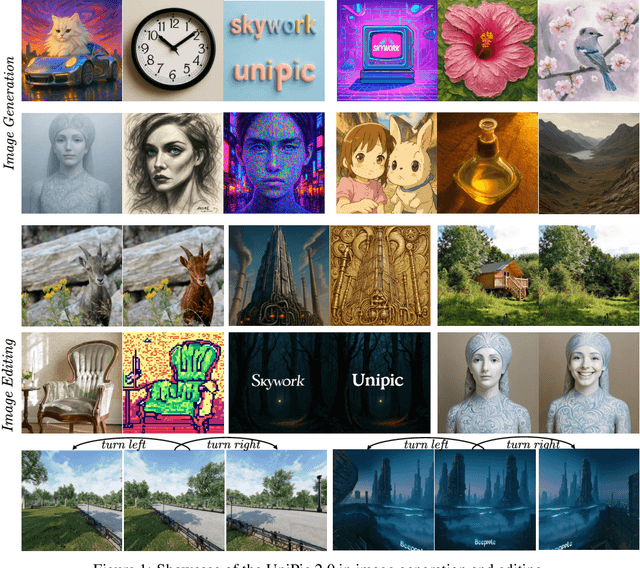
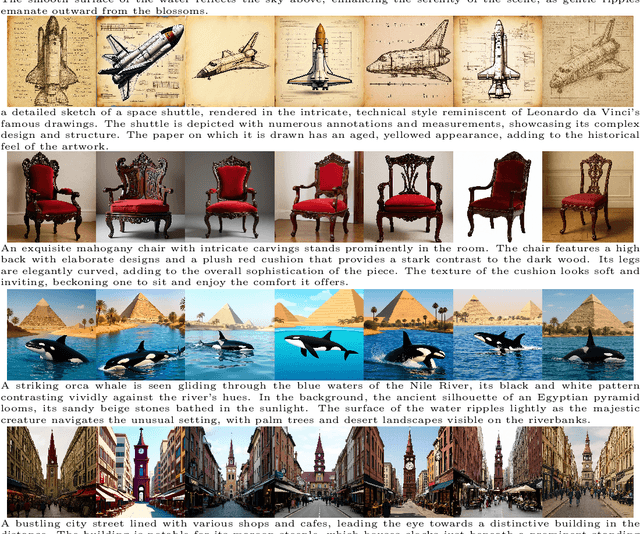
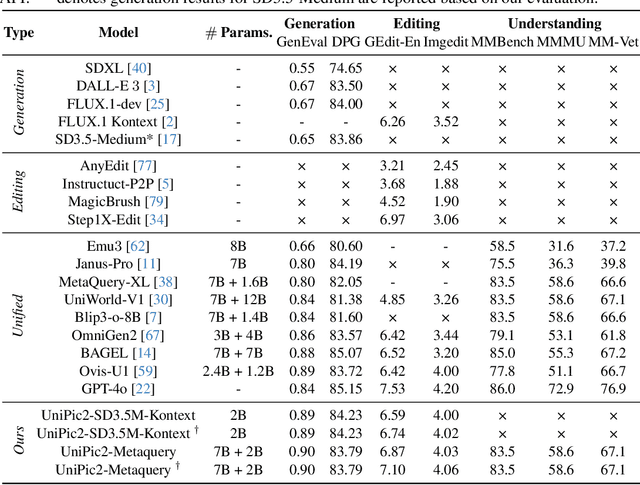
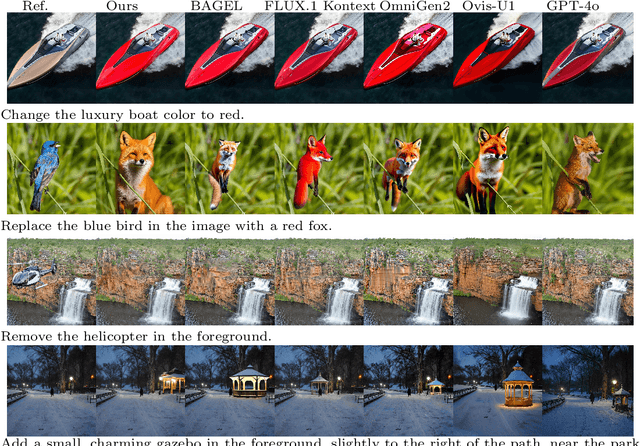
Recent advances in multimodal models have demonstrated impressive capabilities in unified image generation and editing. However, many prominent open-source models prioritize scaling model parameters over optimizing training strategies, limiting their efficiency and performance. In this work, we present UniPic2-SD3.5M-Kontext, a 2B-parameter DiT model based on SD3.5-Medium, which achieves state-of-the-art image generation and editing while extending seamlessly into a unified multimodal framework. Our approach begins with architectural modifications to SD3.5-Medium and large-scale pre-training on high-quality data, enabling joint text-to-image generation and editing capabilities. To enhance instruction following and editing consistency, we propose a novel Progressive Dual-Task Reinforcement strategy (PDTR), which effectively strengthens both tasks in a staged manner. We empirically validate that the reinforcement phases for different tasks are mutually beneficial and do not induce negative interference. After pre-training and reinforcement strategies, UniPic2-SD3.5M-Kontext demonstrates stronger image generation and editing capabilities than models with significantly larger generation parameters-including BAGEL (7B) and Flux-Kontext (12B). Furthermore, following the MetaQuery, we connect the UniPic2-SD3.5M-Kontext and Qwen2.5-VL-7B via a connector and perform joint training to launch a unified multimodal model UniPic2-Metaquery. UniPic2-Metaquery integrates understanding, generation, and editing, achieving top-tier performance across diverse tasks with a simple and scalable training paradigm. This consistently validates the effectiveness and generalizability of our proposed training paradigm, which we formalize as Skywork UniPic 2.0.